How to Design the Perfect Fence Screen for Your Job Site: A Visual Guide

On most construction sites, the fence is the first thing people see. Before the foundation is poured, before the structure rises, before any signage goes up inside the site, the fence line becomes the public-facing edge of the project. For passersby, nearby residents, inspectors, and potential clients, that fence quietly sets expectations. This is where construction fence screen design starts doing real work.
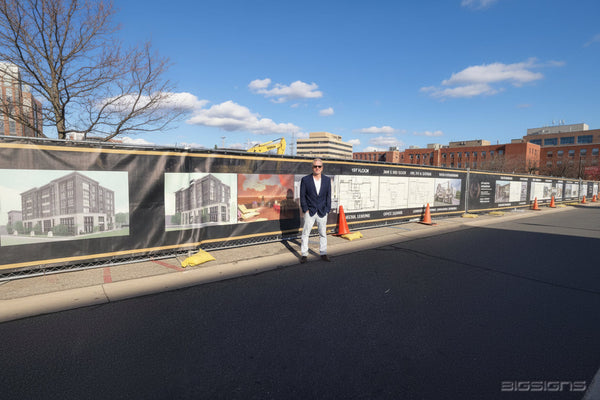
A temporary site doesn’t have to look temporary. A thoughtfully designed fence screen can make an active job site feel intentional, organized, and professional. In many cases, it becomes the strongest branding touchpoint on the project. Unlike banners or small boards that get lost visually, a continuous fence screen commands attention simply by scale. When the design is done right, it elevates perception, communicates credibility, and signals that the contractor cares about details even before the build is complete.
As construction sites increasingly sit in high-visibility urban and suburban areas, the importance of design has grown. A strong construction fence screen design turns a functional requirement into a reputation-building asset, and that shift is what makes branded windscreens such a powerful tool today.
Key Takeaways
-
The fence line is the most visible branding surface on a construction site.
-
A strong construction fence screen design improves professionalism and public perception.
-
Layout, material choice, and readability directly affect impact and longevity.
-
Co-branding and compliant information can be integrated without clutter.
- Professional design support ensures screens perform visually in real-world conditions.
Understand Your Fence Type and Layout
Before design even begins, understanding the physical fence is essential. Not all construction fences are the same, and each type affects how a construction fence screen design should be planned.

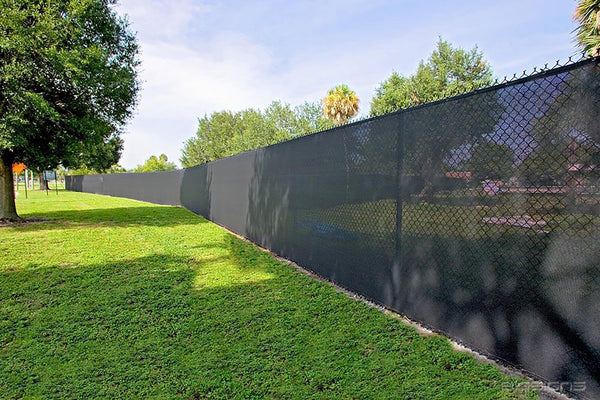
Chain-link fences are the most common and usually allow for continuous runs of screen material. Panel fencing, often used for temporary urban sites, introduces seams and joints that must be accounted for in layout. Temporary barricades may require modular designs rather than long, uninterrupted graphics. Each setup changes how graphics align, repeat, or break across sections.
Accurate dimensions are critical. Designers need to know fence height, panel width, total run length, and any interruptions like gates or corners. Without this information, logos may land awkwardly, text may be cut off, or designs may feel unbalanced once installed. A successful jobsite fence screen layout starts with precise measurements and an understanding of how the fence will be viewed from the street.
What to Include in Your Design
Once the layout is understood, the next question is content. The most effective construction fence screen design balances branding, information, and clarity without overwhelming the viewer.
Logos should be prominent but not oversized to the point of distortion. They need breathing room so they read cleanly from a distance. Many local regulations also require license numbers, contractor names, or contact details to be displayed. Instead of treating these as add-ons, smart designs integrate them seamlessly so compliance doesn’t disrupt visual flow.
Beyond required information, many contractors include a short project tagline, website, or phone number. This turns the fence into a passive lead generator. The key is restraint. Too much text reduces impact and readability. Good fence wrap design tips emphasize hierarchy, ensuring the eye knows where to look first, second, and last.
Also Read: Construction Fence Screen vs Privacy Fence Screen: What’s Best for Your Job Site?
Design for Distance and Impact
Fence screens are rarely viewed up close. Most people see them from across the street, from a moving vehicle, or while walking past. This reality should shape every design decision.
Font size matters more than many realize. Small text may look fine on a proof but becomes illegible at real-world distances. High contrast between text and background improves readability, especially in varying light conditions. Clean, bold typography almost always outperforms decorative fonts on construction fencing.
Minimalist layouts tend to work better than overly detailed designs. A crowded urban site benefits from simplicity because visual noise is already high. In contrast, large open commercial builds may allow for slightly more detail since viewers have more time and space to take in the message. The best construction fence screen design adapts to its environment rather than forcing a one-size-fits-all approach.
Add Branding for Subcontractors or Partners

Construction projects are collaborative by nature. Architects, engineers, suppliers, and subcontractors all contribute to the final result. A fence screen provides an opportunity to acknowledge those partnerships without diluting the primary brand.
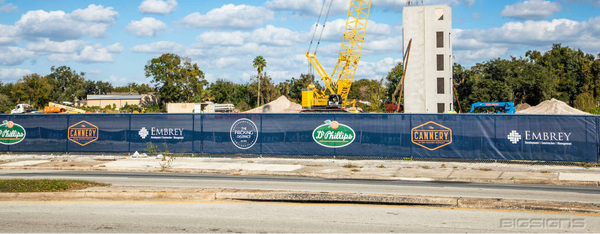
Co-branding can be handled through secondary logo placement or designated sections of the screen. When done thoughtfully, it adds credibility by showing the scale and seriousness of the project team. In some cases, subcontractors or sponsors contribute financially in exchange for visibility, helping offset the cost of the screen itself.
From a design perspective, balance is critical. The main contractor’s identity should remain dominant, while partner logos support rather than compete. Strong contractor fence signage ideas respect this hierarchy, ensuring the fence reads as cohesive rather than cluttered.
Choose the Right Material for Design Longevity
Design does not exist independently of material. The same graphic can look and perform very differently depending on what it’s printed on. Choosing the right material is a core part of effective construction fence screen design.
Lightweight mesh options like DuraMesh® are well-suited for short-term projects or high-wind environments where airflow is critical. They handle bold graphics well but are best paired with simpler designs to maintain clarity. For long-term projects or high-profile sites, heavier options like LogoScreen® Premium84 offer improved print fidelity, durability, and color retention.
Material choice affects how colors appear, how fine details reproduce, and how long the design remains visually sharp. Tying design complexity to material capability ensures the screen looks good not just on day one, but throughout the life of the project.
Use Professional Design Support (Don’t DIY It)
While it may be tempting to repurpose existing marketing assets, fence screens are a specialized format. Files designed for digital or print brochures often fail when scaled to fence-sized applications.
Professional design support accounts for mesh texture, wind movement, viewing distance, and installation constraints. BIGSIGNS offers layout and design assistance specifically optimized for custom construction windscreen printing. This ensures logos are placed correctly, text remains legible, and the final product performs as intended in outdoor conditions.
Investing in professional support reduces revisions, prevents costly mistakes, and results in a screen that enhances rather than detracts from your brand.
Design That Builds Your Reputation
Every construction site tells a story. A strong construction fence screen design tells one of competence, care, and credibility. It shapes how the public perceives your work long before the project is complete.
Great design doesn’t just look good. It builds trust, reinforces brand recognition, and opens doors to future opportunities. In competitive markets, these subtle advantages often make a meaningful difference.
Ready to Start Designing Your Custom Fence Screen?

If you’re ready to elevate your job site, start with a professionally designed fence screen that reflects the quality of your work. Explore material options, request design support, or upload your logo for a free mockup to see how your fence can work harder for your brand.
Frequently Asked Questions
1. What should be included on a construction fence screen design?
A logo, contractor name, and any legally required information should be included, along with optional branding elements like a website or project tagline.
2. How large should logos be on a construction fence screen?
Logos should be large enough to read from the street but balanced so they don’t overpower the design.
3. What’s the best material for a custom construction fence screen?
It depends on project duration and conditions. Lightweight mesh works well for short-term sites, while heavier premium materials suit long-term projects.
4. Can fence screen designs include safety messaging and branding?
Yes. Many designs integrate safety notices with branding in a clean, compliant layout.
5. How do I make sure my fence screen design is readable from the street?
Use large fonts, high contrast colors, and minimal text to ensure clarity at a distance.
6. Can the same design be reused across multiple sites?
Yes, designs can be adapted and resized for different fence layouts while maintaining consistency.
7. Do local regulations affect fence screen design?
Some cities require specific information to be displayed. It’s important to review local rules before finalizing the design.
Recommended Signage & Graphics for Construction Projects
Not sure which signage or graphic products are best for your job site? Use this quick guide to match our most popular construction solutions with your specific needs.
| Use Case / Area | Recommended Product Types |
|---|---|
| Perimeter Branding | Fence Screens (LogoScreen®, DuraMesh), Windscreens |
| Job Site Safety | Directional Signs, Floor Decals |
| Promotions / Visibility | Pole Banners, Building Wraps, Wall Graphics |
| Company Branding | Lobby Signs, Wall Logos, Window Graphics |
| Temporary Messaging | Curb Signs |
| Ground Applications | Floor Graphics |
Need help choosing the right signage? Contact our team for a free recommendation or mock-up.

Ready to see your design?
Tell us what you're branding and send your logo. We'll send a free digital mock-up and a quote.
Prefer to talk? Call 800-790-7611
Get A FREE Mock-Up & Quote
Let customers speak for us
The fence scrim was well received on the site. The Superintendent said it was the nicest scrim he's ever had. Great job!

Hi Mario, thanks for following up. The graphic looks great and we are very happy with the results. Thanks so much for the easy process and great service.
Thank you so much!
Everybody loves the product, so we expect to get some more.

It looks great- and the quality is way better than expected. Sorry it was a bit of a hassle. Thanks again!!!

We ordered windscreens to help advertise our new residential development, and they turned out great. Todd Simms was extremely helpful every step of the way—whether it was design, shipping, or answering any questions we had. Overall, excellent customer service and a great product.
Corey I want to thank you for your patience throughout this entire process. You have been fantastic and I am extremely excited to see how these look. Thank you so much.

I chose BIGSIGNS because I was impressed that they have worked with major colleges all over the U.S., and their prices were very reasonable. I absolutely loved working with Mario in sales. I'll admit, I probably wasn't the easiest customer due to my indecisiveness, but he was incredibly patient and helped make the process smooth from start to finish. The team completely nailed our project, and I already recommended them to others. The final result over-exceeded my expectations. This was a big-time project for a smaller school, and my goal was to have people see it and be wowed. Mission accomplished!

Mario, we used the banner as a backdrop for a trade show last weekend. It was a huge success!
We received our step and repeat a couple of days ago and it turned out great!!!! Thank you for your patience working with me until I made a decision on a design. We actually took it to a job fair yesterday and had people comment on it. In fact, I just sent your contact information to a gentleman from Amherst ISD. His name is Jose Gonzales. I hope he contacts you because he seemed very interested. I will definitely refer others to you in the future as well. Once again, thank you for all you did for us. I know we will get many uses out of it.Thanks- Jarod

Let me start off by saying the signage is even more impressive in person than in your brochures or mock ups, which is hard to do. I love most everything about it. Also appreciate you guys busting your ass to get it done for our regionals tomorrow. You should feel free to use me as a reference if desired. The back of the scoreboard was done as well and looked fantastic. The back of the dugout was also done and looked great. Pretty impressive really. Thanks
Over 400,000 runners will cross a Rock n Roll Marathon or 1/2 Marathon finish line, all of them crossing a BigSigns GatorAd finish line, specially formulated as non-slip safe no matter the weather! Thank you, BigSigns!

BIGSIGNS's ModStar gave us the ease of use, customization, and portability we needed. Modstar displayed sponsors for all seventeen nation-wide Game Breakers events; we are now repurposing the existing frames with new branding for our Copa-de-Calle events.

Just wanted to let you know HOW FANTASTIC the banner is. We have had so many compliments on this banner. Thank you!!!

This is Stevie Medina with the Raton Tiger booster club over in Raton. I just wanted to say thank you for those on deck circles. They're amazing. We gave them out to the softball team and the baseball team. And they were super stoked to get them. They loved them. A lot of the kids like, what are those? Those are so cool. Those are so neat. So they really got a kick out of them. Appreciate you. How quickly you guys turn those around. Boy, we had them super fast. I just wanted to say thank you. Thank you much. And no need to return my phone call. I just wanted to let you know that we're enjoying them. And we appreciate all your help on it.

Ordered a door skin for our volleyball program. Customer service department was great ensuring the order was completed correctly in the end. Design team was accommodating with changes & requests to create a great final product!