Recommended Sizing Chart by Fence Height

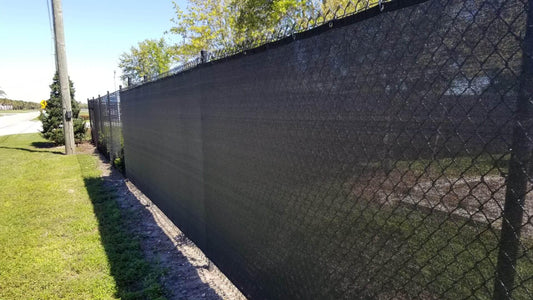
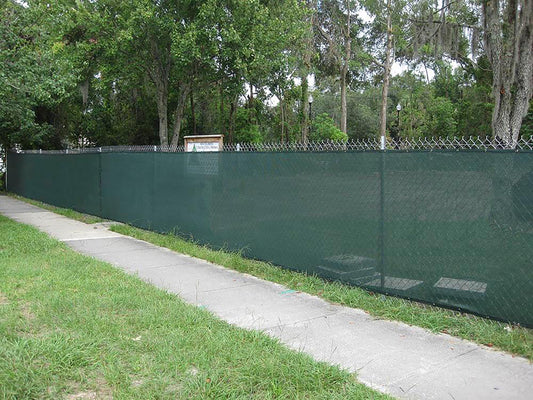
For standard installations, fence screens are typically sized 6 inches shorter than the fence height.

For high-wind areas, reduce the screen height by 8 to 12 inches to improve airflow and reduce stress on the fence.

Fence Screen Sizing Chart

Fence Height Screen Height Screen Size Range
4' Fence 42" 36"–40"
5' Fence 54" 48"–52"
6' Fence 66" 60"–64"
7' Fence 78" 72"–76"
8' Fence 90" 84"–88"
9' Fence 96" 96"
10' Fence 108" 108"

Note: For 9-foot and 10-foot fences, BigSigns recommends sizing screens 12 inches shorter than the fence height as a standard best practice. Taller fences carry greater wind load, and the larger gap at the bottom improves airflow and helps protect both the screen and the fence.

The Standard Sizing Rule

For most permanent installations on chain link fencing, the rule of thumb is straightforward:

Order your fence screen 6 inches shorter than your actual fence height.

The 6-inch gap is intentional. It helps in three ways:

  • Improves airflow

    The gap reduces wind load on the fence and screen.

  • Protects the screen

    Keeping the screen off the ground helps protect it from lawn equipment, foot traffic, puddling, mud, and ground debris.

  • Hides minor fence height variation

    Chain link fences are rarely perfectly level along their full length. A 6-inch buffer helps prevent visible fit issues along uneven runs.

Measure your fence height in multiple locations and use the lowest measurement as your reference. Building to the lowest point helps the screen sit cleanly across the entire run.

BigSigns.com

High-Wind Sizing Adjustment

If your installation is in a high-wind environment, size your screen 8 to 12 inches shorter than the fence.

High-wind environments may include:

  • Coastal properties
  • Plains or open fields
  • Stadium-top installations
  • Exposed industrial sites
  • Tall ridgeline sites
  • Locations with sustained winds above 25 mph

This adjustment helps:

  • Increase airflow through the bottom of the fence
  • Reduce wind load on the screen
  • Reduce stress on the fence structure
  • Extend the life of the screen
  • Lower the risk of fence damage during extreme wind events

The trade-off is a slightly larger visible gap at the bottom.

For privacy-focused installations where the bottom gap is a concern, talk to a BigSigns specialist about higher-airflow mesh options that maintain privacy while still reducing wind stress.

Sizing Tall Fences

For 9-foot and 10-foot fences, the standard 6-inch reduction is not enough.

Taller fences create more wind load because every additional foot of screen height adds sail area. The leverage on the fence posts also increases as the screen gets taller.

BigSigns recommends sizing 9-foot and 10-foot fence screens 12 inches shorter than the fence height as a standard best practice.

Recommended tall fence sizes:

Fence Height Recommended Screen Height
9’ Fence 96”
10’ Fence 108”

If your tall fence is also in a high-wind environment, consult with a BigSigns specialist about:

  • Reinforced hems
  • Higher-airflow mesh
  • Panel-by-panel sizing
  • Fastener spacing
  • Installation method

How to Measure Your Fence

Before placing an order, measure the fence carefully. Accurate measurements are the difference between a clean installation and a panel that does not fit correctly.

You will need:

  • A 100-foot or 300-foot tape measure for fence length
  • A 25-foot tape measure for fence height
  • A notepad or grid pad
  • A pencil
  • Step 1: Sketch the Site Layout

    Draw the fence on your notepad and include at least one fixed landmark, such as:

    • Northwest corner
    • Gate at building entrance
    • Dugout opening
    • Main access road
    • Left-field foul pole
    • Construction trailer

    This helps keep panels labeled correctly when the order is fabricated, packed, shipped, and installed.

  • Step 2: Measure the Fence Height

    Measure the fence height in multiple locations along the run.

    Chain link fencing is rarely perfectly level, especially on older installations or sloped sites.

    Use the lowest height measurement as your reference. Note the height on your sketch.

  • Step 3: Measure Each Fence Section

    Measure each section of fence from outside tension bar to outside tension bar.

    Do not measure post to post. Do not include gate openings in a continuous fence run.

    For each section, deduct slightly to account for tension bar hardware. The exact deduction should be confirmed with a BigSigns specialist when ordering, but it is typically 1 to 3 inches depending on hardware and section length.

    For ease of handling and installation, each panel should generally not exceed 50 feet.

    Round measurements down to the nearest half inch.

  • Step 4: Measure Gates Separately

    If your fence has gates, measure each gate separately from outside tension bar to outside tension bar.

    Gates may need separate screen panels so they can swing freely. Do not include gate openings as part of the main fence run unless directed by a BigSigns specialist.

  • Step 5: Number Each Section on Your Diagram

    Assign each fence section a unique number on your diagram.

    For example:

    • Panel 1: Left field fence
    • Panel 2: Center field fence
    • Panel 3: Right field fence
    • Panel 4: First-base dugout
    • Panel 5: Third-base dugout

    Your panels can then be fabricated and labeled with these numbers, which makes installation much faster.

  • Step 6: Note Any Height Changes

    Mark anywhere the fence height changes along the run.

    Different heights may require different panel sizes. Confirming this on the diagram helps prevent reorders, installation delays, and mismatched panels.

Sizing by Application

The standard chart applies to most installations, but specific use cases have their own sizing conventions.

Tennis and Pickleball Courts

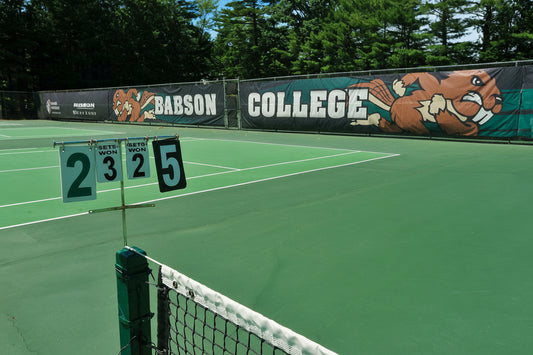
Tennis fences are typically 10 or 12 feet tall, but tennis windscreen is conventionally 6 or 9 feet tall, not full fence height.

The screen is usually centered vertically on the fence to create a backdrop for ball visibility while leaving the top of the fence open.

To center the screen:

  1. Subtract the screen height from the fence height.
  2. Divide the difference by two.
  3. Use that distance from the top of the fence as your installation line.

Example:

A 12-foot fence with a 9-foot windscreen:

12' - 9' = 3'

3' ÷ 2 = 1.5'

Install the screen approximately 1.5 feet down from the top of the fence.

Mark a chain link knuckle at this height to create a consistent reference line during installation.


Baseball and Softball Outfields

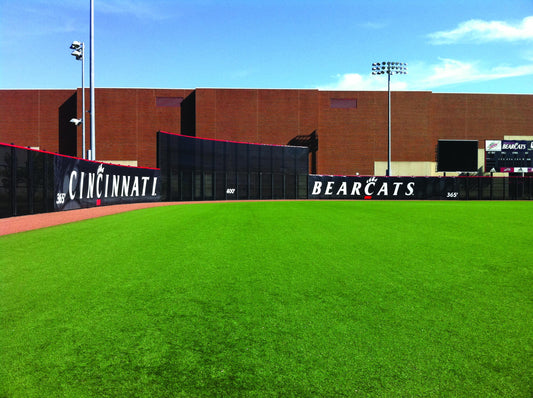
Baseball and softball outfield fences are typically 6 to 8 feet tall. In most cases, the screen should be sized using the standard chart.

For example:

  • 6-foot fence: 66-inch screen
  • 8-foot fence: 90-inch screen

Dugout wraps and dugout fence screens are sized differently. Measure the dugout opening directly rather than applying the standard fence-height rule.

Recommended product pages:


Football, Soccer, and Stadium Fences

Stadium-perimeter screens often carry sponsor logos, school branding, team graphics, or event signage.

For these installations, sizing should account for both:

  • Fence height
  • Graphic layout

Apply the standard sizing chart, but verify that the screen height supports the artwork layout. For multi-panel sponsor graphics, the panel sizing should allow the artwork to align cleanly across seams.

In many stadium applications, the final screen height is determined by the graphic layout rather than the fence alone.


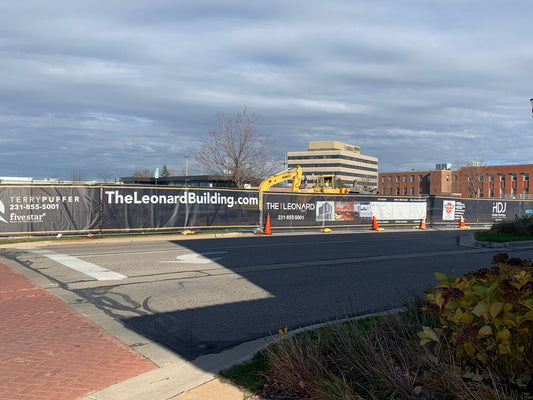
Construction Job Sites on Permanent Chain Link

Construction fences on permanent chain link usually follow the standard sizing chart.

For high-wind job sites, apply the high-wind adjustment and size the screen 8 to 12 inches shorter than the fence.

High-wind construction environments may include:

  • Exposed corners
  • Coastal builds
  • Ridgeline sites
  • Open industrial sites
  • Long uninterrupted fence runs

Sizing for Custom Printed Fence Screen

Custom printed fence screens carry graphics such as:

  • Logos
  • Sponsor artwork
  • Jobsite branding
  • Athletic team marks
  • Directional signage
  • Event graphics

Sizing custom printed screens requires attention to both the fence dimensions and the artwork layout.


Build in Bleed Margin

Include a 2-inch to 3-inch bleed margin on every side of the graphic.

This allows artwork to extend past the visible field of the panel and helps prevent white edges or awkward cutoffs if the panel shifts slightly during installation.


Plan for Grommet Zones

Grommets are typically placed along the top, bottom, and sides of the panel.

Keep critical artwork elements at least 2 inches from the panel edge so grommets do not interfere with:

  • Logos
  • Phone numbers
  • Website URLs
  • Sponsor names
  • QR codes
  • Important text

Size Multi-Panel Graphics Carefully

If a single sponsor logo or design spans multiple panels, the panel sizes should be planned so the graphic lands cleanly across the seams.

For example, a logo that crosses two panels should not have important text, faces, or QR codes directly on the seam.


Confirm Panel Dimensions Before Final Artwork

Confirm the final panel dimensions with BigSigns before final artwork is built.

Once the panel size is locked, the artwork file should be sized to match the panel, not the other way around.

For complex multi-panel installations such as stadium perimeters or large jobsite branding, the BigSigns design team can build the layout to match the fence so the artwork reads continuously across the installation.

BigSigns.com

Non-Standard Fences and Custom Sizing

Not every fence is a clean 6-foot or 8-foot chain link fence.

Custom sizing is recommended if your installation includes:

  • Stepped fences
  • Wrought iron fencing
  • Wood fencing
  • Sloped ground
  • Curved fences
  • Privacy fences over 12 feet tall
  • Roll product cut on site
  • Multiple fence heights in one run
  • Unusual gate configurations

For these situations, contact a BigSigns specialist before ordering.

Custom-fabricated panels are not returnable, so getting sizing right the first time matters.

Talk to a BigSigns specialist

Common Sizing Mistakes

  • Ordering the Screen the Same Height as the Fence

    Fence screen should not usually be the same height as the fence.

    A full-height screen can create wind load problems, grommet failure, and excess wear at the bottom. Always size shorter than the fence unless BigSigns specifically recommends otherwise for your application.

  • Measuring Only at One Point

    Chain link fencing is rarely perfectly level.

    If you measure only at one point, you may accidentally size the screen based on the highest section of the fence. This can cause bunching, dragging, or uneven appearance.

    Measure in multiple places and use the lowest height as your reference.

  • Ignoring Wind Environment

    Standard sizing may not be appropriate for high-wind sites.

    If your site regularly sees sustained winds above 25 mph, use the high-wind adjustment from the start.

  • Forgetting Bleed on Custom Graphics

    Custom-printed screens without proper bleed margins may show white edges or cut-off artwork after installation.

    Always plan for 2 to 3 inches of bleed on every side.

  • Not Accounting for Tension Bar Hardware

    Measuring post to post instead of tension bar to tension bar can produce panels that do not fit correctly.

    Measure from outside tension bar to outside tension bar and confirm the correct deduction with your BigSigns specialist when ordering.

  • Sizing 9-Foot and 10-Foot Fences With the Standard 6-Inch Rule

    Tall fences need a larger reduction.

    For 9-foot and 10-foot fences, BigSigns recommends sizing the screen 12 inches shorter than the fence height as a standard best practice.

Frequently Asked Questions

What size fence screen do I need for a 6-foot fence?

For a 6-foot fence, order a 66-inch fence screen. That is 6 inches shorter than the fence height, which is the BigSigns standard for permanent chain link installations. For high-wind areas, use a 60-inch to 64-inch screen.

What size fence screen do I need for an 8-foot fence?

For an 8-foot fence, order a 90-inch fence screen as the standard size. For high-wind areas, use an 84-inch to 88-inch screen.

What size fence screen do I need for a 10-foot fence?

For a 10-foot fence, BigSigns recommends a 108-inch fence screen. That is 12 inches shorter than the fence height. The 12-inch reduction is the standard best practice for fences 9 feet and taller because tall fence systems carry greater wind load.

Why is the fence screen shorter than the fence?

The gap at the bottom is intentional. It improves airflow, reduces wind load on the fence, protects the screen from lawn equipment and ground debris, and helps account for minor variations in fence height along the run.

How do I measure my fence for a windscreen?

Measure the fence height in multiple locations and use the lowest measurement. Measure each section length from outside tension bar to outside tension bar. Sketch the site with a landmark for reference and number each section on the diagram.

Should the windscreen be tighter in high-wind areas?

No. In high-wind areas, the screen should be sized shorter and installed with slight flexibility. A tighter installation increases stress on the screen, fasteners, and fence structure.

Can I order a custom-sized fence screen?

Yes. BigSigns fabricates custom-sized fence screen panels for non-standard fences, including stepped fences, curved sections, sloped ground, and taller-than-standard heights. Contact a specialist before ordering custom-fabricated screen because custom panels are not returnable.

How is tennis court windscreen sized differently?

Tennis windscreen is typically 6 or 9 feet tall on a 10-foot or 12-foot fence, not full fence height. The screen is centered vertically on the fence to create a backdrop for ball visibility while leaving the top of the fence open.

Do you have a sizing calculator?

The chart on this page covers standard fence heights from 4 feet to 10 feet. For non-standard fences or large multi-section installations, a BigSigns specialist can size every panel individually based on your site sketch and measurements.

Need Help Sizing Your Fence Screen?

For multi-section installations, tall fences, custom graphics, or unusual fence configurations, a BigSigns specialist can size every panel based on your site sketch and recommend mesh and reinforcement options.