The Complete Guide to Fence Screens

Whether you're managing a construction site, maintaining a baseball field, or adding privacy to your backyard, fence screens offer a versatile solution that goes way beyond just blocking the view. These durable fabric barriers have become essential tools for businesses, sports facilities, and homeowners who need temporary or semi-permanent screening that actually works.
Fence screens serve multiple purposes depending on where you use them. On construction sites, they control dust and debris while creating branded barriers that turn eyesores into marketing opportunities. Sports facilities use them to reduce wind interference and display sponsor logos. Homeowners rely on them for instant privacy without the cost of permanent fencing.
This guide covers everything you need to know about choosing, customizing, and installing fence screens for your specific situation.
Key Takeaways
-
Fence screens come in mesh and solid vinyl materials, each suited for different wind conditions and privacy needs
-
Construction sites benefit from custom printed screens that provide branding, safety compliance, and dust control in one solution
-
Sports field screens reduce wind by up to 85% while offering prime real estate for sponsor advertising
- Proper installation takes 2-4 hours for most projects and requires basic tools like zip ties, tensioning cables, and a ladder
What Is a Fence Screen?

A fence screen is a large piece of durable fabric material designed to attach to chain-link or wire fencing. Think of it as a giant tarp specifically engineered to withstand outdoor conditions while serving practical purposes like privacy, wind reduction, or visual blocking. You might hear them called windscreens, privacy screens, fence mesh, or barrier screens, but they're all variations of the same basic product.
The fabric itself is typically made from knitted polyethylene mesh or solid vinyl-coated polyester. These materials are UV-stabilized, meaning they won't fall apart after a season in the sun. Most screens come with grommets (metal-ringed holes) along the edges for easy attachment using zip ties, bungee cords, or rope.
Fence screens differ from privacy slats or traditional solid fencing in important ways. They're temporary or semi-permanent, making them perfect for projects with defined timelines. They're also significantly more affordable than building permanent structures.
Common uses include construction site barriers, baseball and softball outfield screens, tennis court windscreens, pool enclosures, and residential privacy solutions. According to the American Rental Association, temporary fence screening has become one of the fastest-growing categories in equipment rental.
The beauty of fence screens is their flexibility. You can move them, resize them, print custom graphics on them, and remove them when the job is done without leaving permanent changes to your property.
Types of Fence Screens by Application
1. Construction Fence Screens

Construction fence screens have become standard equipment on job sites across the country. These heavy-duty barriers serve multiple critical functions that go well beyond just hiding the mess.
First, there's dust and debris control. Construction activities kick up enormous amounts of particulate matter that can drift into neighboring properties. A quality construction windscreen blocks up to 90% of airborne particles, keeping your site compliant with local air quality regulations. OSHA guidelines actually recommend using physical barriers as part of dust control strategies on many types of projects.
Privacy and security are equally important. Construction sites contain expensive equipment and sometimes hazardous conditions. Screening prevents casual observation from passersby, reducing theft opportunities and limiting liability concerns.
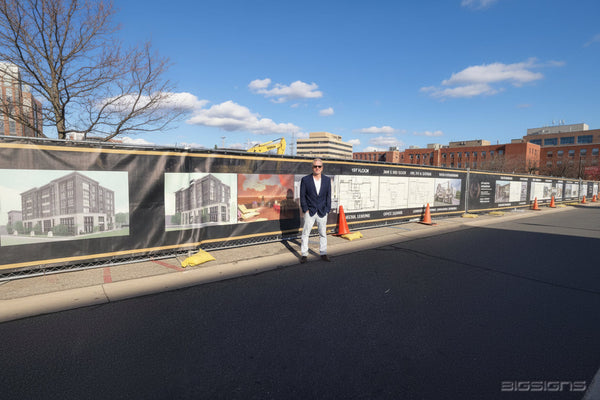
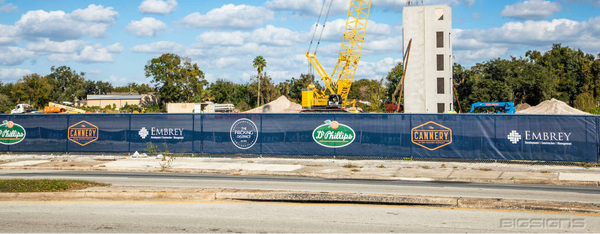
The third advantage is branding and community relations. A professionally printed construction fence screen with your company logo, project renderings, and contact information transforms dead space into a billboard that works 24/7.
For job-site branding that doubles as visibility control, custom printed construction fence banners can be sized to any fence line and printed edge-to-edge with your company logo and colors.
Modern construction fence screens typically come in 6-foot or 8-foot heights with custom lengths up to 200 feet or more. The mesh density (usually 70-90% blockage) strikes a balance between privacy and wind resistance.
Check out our dedicated construction fence screen page for specific products designed for job site applications, including options with reinforced hems and custom printing.
2. Sports Field Fence Screens

Baseball and softball facilities have been using fence screens for decades. If you've ever played or watched a game on a windy day, you know how much a stiff breeze can affect fly balls and overall playing conditions. A proper baseball fence screen can reduce wind speeds by 70-85%, creating much more consistent playing conditions.
Outfield screens serve the dual purpose of wind reduction and visual background. Batters need a solid, contrasting background behind the pitcher to pick up the ball's release point. A screen in center field (usually in a dark green or black color) provides this crucial visual aid.
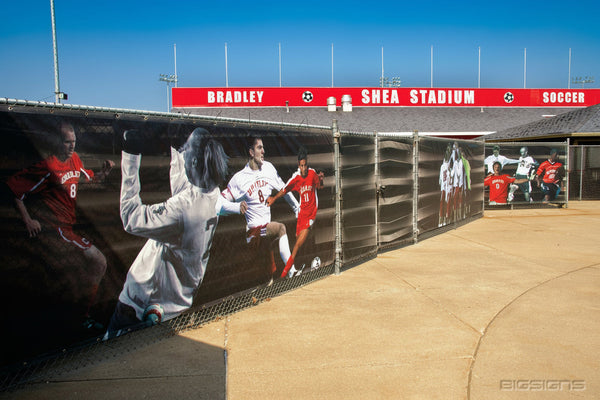
The softball windscreen market has exploded as more facilities recognize the dual benefits of improved playing conditions and sponsorship revenue. A 300-foot perimeter screen offers roughly 1,800 square feet of advertising space. At typical sponsorship rates, that screen can pay for itself in a single season.
Modern sports field screens use UV-resistant mesh that maintains color vibrancy for 5-7 years. The printing process has advanced significantly too. Full-color digital printing means you can reproduce detailed sponsor logos and complex designs that look sharp from both the field and the stands.
Our fence screen for baseball and softball options include regulation sizes and custom printing services designed specifically for athletic facilities.
3. Privacy Fence Screens

Residential and commercial privacy applications represent the fastest-growing segment of the fence screen market. Homeowners are discovering that privacy screens offer an affordable alternative to expensive fence upgrades or landscaping projects that take years to mature.
Common residential uses include pool and patio enclosures, balcony privacy, and temporary screening for events. Commercial applications range from rooftop deck privacy to screening mechanical equipment, dumpster enclosures, and outdoor storage areas.
Privacy screens come in various opacity levels. A 90-95% blockage mesh provides near-total privacy while still allowing some airflow. Solid vinyl screens offer 100% privacy but require more robust mounting due to increased wind load.
The installation process for residential privacy screens is simpler than commercial applications because the sections are usually smaller. Many homeowners successfully install their own screens using basic tools and following manufacturer instructions.
Fence Screen Materials: Mesh vs. Solid Vinyl
Choosing between mesh and solid vinyl fence screens depends on your specific needs, budget, and environmental conditions.
Mesh Fence Screens (Knitted Polyethylene)
Mesh screens use a knitted construction that allows some air and light to pass through while blocking visibility and reducing wind. The "percentage" (like 70% or 90%) refers to the blockage factor.
Advantages include better wind resistance due to air permeability, lighter weight making installation easier, lower cost compared to solid vinyl, and excellent durability in high-wind environments.
Solid Vinyl Fence Screens
Solid vinyl screens use a vinyl-coated polyester fabric that blocks 100% of light and visibility. These are the go-to choice when complete privacy is the primary goal.
Advantages include total privacy, superior graphic quality for printed designs, and a more finished, professional appearance. The main disadvantage is wind load. Solid screens catch wind like a sail, putting significant stress on fence posts.
Comparison Table
|
Feature |
Mesh Screen (80-90%) |
Solid Vinyl Screen |
|
Privacy Level |
High (not complete) |
Complete (100%) |
|
Wind Resistance |
Excellent |
Requires reinforced mounting |
|
Cost |
$$ |
$$$ |
|
Best For |
Construction sites, sports fields, windy areas |
Residential privacy, graphic fence screen applications |
|
Lifespan |
3-5 years |
5-7 years |
|
Graphic Quality |
Good |
Excellent |
For most applications, an 80-90% mesh offers the best balance of privacy, durability, and cost-effectiveness.
Custom Printed Fence Screens
Custom fence windscreen printing has transformed these functional barriers into powerful marketing tools. What used to be plain colored mesh can now display your company logo, project renderings, sponsor advertisements, or virtually any graphic you can imagine.
The printing process uses large-format digital printers with UV-resistant inks designed to withstand years of sun exposure. The best manufacturers use dye-sublimation or direct-to-fabric printing that bonds ink to the fence mesh fibers.
Design Considerations
When creating graphics for a construction fence screen with logo, keep these guidelines in mind. Bold designs with good contrast work best on mesh material. Consider viewing distance (typically 20-100 feet away) and size elements appropriately. Your logo might need to be 3-4 feet tall to have proper impact.
Turnaround Times and Pricing
Standard turnaround for custom printed fence screens is typically 7-10 business days from approved artwork. The printing cost adds roughly 30-50% to the base screen price, but the marketing value often justifies this investment.
How to Choose the Right Fence Screen
1. Determine Your Primary Purpose
Start by identifying what you most need the screen to accomplish. Is it privacy, wind reduction, dust control, branding, or some combination? This decision drives everything else. Complete privacy requires higher blockage percentages or solid vinyl. Wind reduction on a baseball field might work best with 80% mesh. Branding requires printable surface area and good graphic reproduction.
2. Measure Your Space Accurately
Fence screens are sold by height and length. Standard heights are 4, 6, 8, 10, and 12 feet. Measure your fence height and add 6-12 inches if you want the screen to extend slightly above the top rail for better coverage.
For length, measure the entire section you want to cover. Screens can be custom cut to specific lengths, or you can purchase standard sizes (usually sold in 50, 100, or 200-foot rolls) and cut them yourself. Most projects benefit from ordering slightly more than you think you need to account for overlaps at seams and gates.
3. Assess Wind Conditions
Local wind patterns significantly impact which material you should choose. Coastal areas, open plains, or rooftop installations experience higher wind loads than protected urban environments or residential backyards.
For high-wind areas, choose mesh screens with 70-85% blockage rather than solid vinyl. The air permeability prevents the screen from acting like a sail. Also plan for reinforced mounting, including top and bottom tensioning cables and attachment points every 12 inches rather than 18.
4. Budget for Complete Installation
A reasonable budget for 100 feet of 6-foot tall mesh fence screen with grommets and zip ties runs about $200-400 for materials. Add another $200-600 for professional installation. Custom printing adds $150-400 depending on design complexity.
Browse our complete selection at fence screens and windscreens collection to see available options.
Fence Screen Installation Guide
Installing a fence screen is a manageable DIY project. Here's the basic process:
Materials Needed: Fence screen, zip ties (about 1 per linear foot), wire tensioning cable (for sections over 50 feet), scissors, ladder, and work gloves.
Step 1: Prepare the Fence
Clean the fence of debris, loose wire, or rust that could snag the screen material. Make any necessary repairs to the chain-link before installation. Check that all posts are secure and the top rail is straight. A sagging fence will produce a sagging screen.
Step 2: Unroll and Position the Screen
Starting at one end post, unroll the screen along the ground parallel to the fence. Position it so grommets align with fence posts or at regular intervals. For screens taller than your fence, decide whether excess height should extend above or below the top rail (above is more common).
Step 3: Attach at Corner Posts
Begin attachment at a corner or end post. Thread a zip tie through the top corner grommet and around the fence post or top rail. Pull tight but not so tight that you deform the grommet. Secure the bottom corner grommet the same way. This anchors the screen at the starting point.
Step 4: Work Along the Top Edge
Move along the fence, attaching the screen at the top edge first. Insert zip ties through grommets and around the top rail, spacing them every 12-18 inches. Maintain slight tension as you go to prevent sagging, but don't pull so tight that you create puckering between attachment points.
According to Family Handyman, consistent tension is the key to professional-looking results. The entire process typically takes 2-4 hours for 100 feet of fence screen.
Step 5: Secure the Bottom Edge
Once the top is completely attached, return to the starting point and work along the bottom edge. Attach grommets to the bottom rail or directly to the chain-link mesh using the same spacing as the top. Some installers prefer slightly tighter tension on the bottom to prevent billowing.
Step 6: Add Vertical Attachments
For added security and a tighter appearance, add vertical zip ties every 3-4 feet from top to bottom. This prevents the screen from ballooning in the wind.
Step 7: Install Tensioning Cables (For Long Runs)
For sections exceeding 50 feet, thread a steel cable through the top row of grommets before attaching to the fence. Secure the cable at both end posts with cable clamps, applying moderate tension. This prevents sagging over time. Repeat along the bottom edge if needed.
Step 8: Trim Excess and Final Inspection
Trim excess zip tie tails for a cleaner appearance. Walk the entire length checking for loose attachments or areas that might catch wind. Make adjustments as needed.
The entire process typically takes 2-4 hours for 100 feet of fence screen, depending on your experience level and whether you're working solo or with help.
Ready to Get Your Custom Fence Screen?
Whether you need a construction windscreen that showcases your brand, a baseball fence screen that reduces wind and displays sponsors, or a privacy solution for your facility, BIGSIGNS has the expertise and products to meet your needs.
Visit our fence screens and windscreens collection to browse available for athletic and sports focussed options, or check out our specialized construction fence screen page for job-site specific solutions.
FAQ: Common Fence Screen Questions
1. What is the best fence screen material for windy areas?
Mesh screens with 70-85% blockage are ideal for high-wind environments. The open weave allows air to pass through rather than catching wind. Look for UV-stabilized knitted polyethylene with reinforced edges. Solid vinyl screens should be avoided in consistently windy areas unless your fence structure is specifically engineered to handle the load.
2. How long do fence screens last outdoors?
Quality fence screens typically last 3-5 years for mesh materials and 5-7 years for solid vinyl when properly installed and maintained. UV-stabilized materials last significantly longer than non-stabilized options. Many manufacturers offer warranties ranging from 1-5 years.
3. Can you print logos on fence screens?
Yes, modern digital printing allows full-color graphics, logos, and text on both mesh and solid vinyl fence screens. The printing uses UV-resistant inks that maintain color for the life of the screen. Turnaround time averages 7-10 business days.
4. What size fence screen do I need?
Measure your fence height and length. Standard heights are 4, 6, 8, 10, and 12 feet. Choose a height that matches or slightly exceeds your fence height. Add 5-10% to length measurements for overlaps.
5. What's the difference between mesh and solid fence screens?
Mesh screens allow partial air and light penetration while blocking 70-95% of visibility. They're more wind-resistant, lighter, and less expensive. Solid vinyl screens block 100% of light and visibility but cost more and require stronger mounting. Choose mesh for construction sites, sports fields, and windy areas. Choose solid vinyl when complete privacy is essential and wind conditions are moderate.

Ready to see your design?
Tell us what you're branding and send your logo. We'll send a free digital mock-up and a quote.
Prefer to talk? Call 800-790-7611
Get A FREE Mock-Up & Quote
Let customers speak for us
The fence scrim was well received on the site. The Superintendent said it was the nicest scrim he's ever had. Great job!
Hi Mario, thanks for following up. The graphic looks great and we are very happy with the results. Thanks so much for the easy process and great service.
Thank you so much!

Everybody loves the product, so we expect to get some more.

It looks great- and the quality is way better than expected. Sorry it was a bit of a hassle. Thanks again!!!

We ordered windscreens to help advertise our new residential development, and they turned out great. Todd Simms was extremely helpful every step of the way—whether it was design, shipping, or answering any questions we had. Overall, excellent customer service and a great product.
Corey I want to thank you for your patience throughout this entire process. You have been fantastic and I am extremely excited to see how these look. Thank you so much.

I chose BIGSIGNS because I was impressed that they have worked with major colleges all over the U.S., and their prices were very reasonable. I absolutely loved working with Mario in sales. I'll admit, I probably wasn't the easiest customer due to my indecisiveness, but he was incredibly patient and helped make the process smooth from start to finish. The team completely nailed our project, and I already recommended them to others. The final result over-exceeded my expectations. This was a big-time project for a smaller school, and my goal was to have people see it and be wowed. Mission accomplished!

Mario, we used the banner as a backdrop for a trade show last weekend. It was a huge success!
We received our step and repeat a couple of days ago and it turned out great!!!! Thank you for your patience working with me until I made a decision on a design. We actually took it to a job fair yesterday and had people comment on it. In fact, I just sent your contact information to a gentleman from Amherst ISD. His name is Jose Gonzales. I hope he contacts you because he seemed very interested. I will definitely refer others to you in the future as well. Once again, thank you for all you did for us. I know we will get many uses out of it.Thanks- Jarod

Let me start off by saying the signage is even more impressive in person than in your brochures or mock ups, which is hard to do. I love most everything about it. Also appreciate you guys busting your ass to get it done for our regionals tomorrow. You should feel free to use me as a reference if desired. The back of the scoreboard was done as well and looked fantastic. The back of the dugout was also done and looked great. Pretty impressive really. Thanks
Over 400,000 runners will cross a Rock n Roll Marathon or 1/2 Marathon finish line, all of them crossing a BigSigns GatorAd finish line, specially formulated as non-slip safe no matter the weather! Thank you, BigSigns!

BIGSIGNS's ModStar gave us the ease of use, customization, and portability we needed. Modstar displayed sponsors for all seventeen nation-wide Game Breakers events; we are now repurposing the existing frames with new branding for our Copa-de-Calle events.

Just wanted to let you know HOW FANTASTIC the banner is. We have had so many compliments on this banner. Thank you!!!

This is Stevie Medina with the Raton Tiger booster club over in Raton. I just wanted to say thank you for those on deck circles. They're amazing. We gave them out to the softball team and the baseball team. And they were super stoked to get them. They loved them. A lot of the kids like, what are those? Those are so cool. Those are so neat. So they really got a kick out of them. Appreciate you. How quickly you guys turn those around. Boy, we had them super fast. I just wanted to say thank you. Thank you much. And no need to return my phone call. I just wanted to let you know that we're enjoying them. And we appreciate all your help on it.

Ordered a door skin for our volleyball program. Customer service department was great ensuring the order was completed correctly in the end. Design team was accommodating with changes & requests to create a great final product!