What Is the Purpose of a Construction Fence Screen?

A construction fence screen is a printed or solid mesh panel that attaches to chain-link or temporary fencing to do five jobs at once: improve safety, harden security, add privacy, control dust and wind, and turn your perimeter into branded advertising space. Most coverage of construction fencing stops at the first four. The fifth purpose, branding, is where a printed screen separates itself from a bare chain-link fence, and it is the reason general contractors and developers increasingly spec a custom construction fence screen instead of plain mesh.
The short version: the fence keeps the site contained, and the screen makes that perimeter safer, quieter, cleaner, and brand-visible. A bare fence does one of those things. A screen does all five. This guide breaks down each purpose and how to match the material to your site.
What is a construction fence screen used for?
A construction fence screen is used to enclose and dress the perimeter of an active job site so it is safer, more private, weather-resistant, and visually branded. It attaches to the outside of a temporary chain-link or panel fence with cable ties, bungees, or grommets every two feet, converting an open metal barrier into a continuous surface. An open fence marks a boundary; a construction fence screen controls what passes through that boundary, including sightlines, wind, dust, and the public's first impression of the project.
The material is almost always knitted polyethylene mesh or printed mesh vinyl, rated by how much light or wind it blocks as a shade or blockage percentage. A 70 to 90 percent mesh blocks most sightlines while letting enough air through to keep the fence standing in wind. A printed mesh vinyl screen carries full-color graphics and logos while still venting air through micro-perforations. The right choice depends on which of the five purposes below matters most for your site.

Safety: keeping the public out and hazards in
The primary purpose of any construction barrier is safety, and a screen strengthens it by removing the open sightlines and handholds of a bare fence. An open chain-link fence is climbable and invites curiosity; a screened fence is a solid visual wall that signals "active hazard, do not enter." It keeps pedestrians, children, and trespassers away from excavations, heavy equipment, and fall hazards, and it keeps falling debris and tools from reaching the sidewalk.
This matters for liability, not just optics. OSHA standards like 29 CFR 1926.502 require sites to protect workers and the public from recognized hazards, and a screened perimeter is part of how contractors document a controlled site; you can read the federal fall-protection requirements in OSHA's 1926.502 standard. A screen also reduces the "attractive nuisance" risk, the legal exposure that comes when an open site draws kids in after hours. For how perimeter graphics fit a full site-safety program, see our complete guide to construction site signage.
Security: protecting equipment, materials, and the schedule
A construction fence screen improves security by blocking the view of what is worth stealing. Theft of copper, tools, fuel, and equipment is one of the largest uncontrolled costs on a job site, with the National Equipment Register and NICB estimating $300 million to $1 billion in equipment theft annually in the U.S. (per NICB reporting on heavy equipment theft). You cannot steal what you cannot see, and a solid screen removes the casual reconnaissance that precedes most after-hours theft.
The security benefit is passive and continuous, so it pays off over a multi-month build. A general contractor on a six-month commercial project who screens the perimeter removes the nightly temptation of visible scaffolding, generators, and material pallets. Pair the screen with a high-blockage mesh, like the Dura-Mesh construction fence screen, and the perimeter reads as a sealed, monitored site rather than an open storage yard.
Privacy: controlling sightlines into the work
A construction fence screen creates privacy by blocking outside views of the work in progress, which protects both the project and the neighbors. For the project, competitors and passersby cannot photograph staging, proprietary methods, or an unfinished facade that does not yet represent the brand. For the community, a screen hides the visual mess of an active site, the mud, the rebar, the half-built structure, which is often a condition of the building permit in residential and downtown zones.
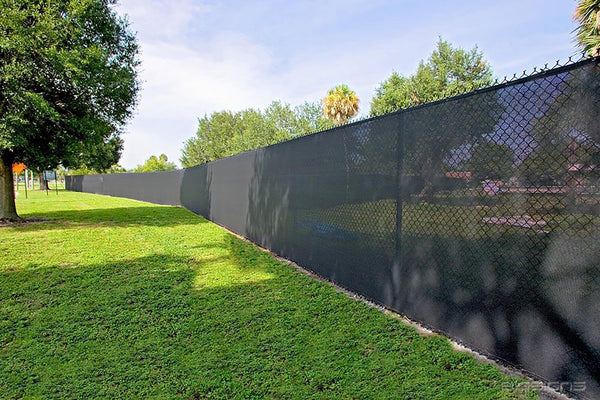
Density is what drives privacy. A privacy-grade screen uses a tighter knit to reach 85 to 95 percent blockage, enough to fully obstruct the view at normal viewing distances. If complete concealment is the goal, a pre-made privacy construction fence screen in a solid neutral color does the job without custom artwork. If you are weighing concealment against airflow and branding, our breakdown of construction fence screen vs privacy windscreen walks through which one fits your site.
Dust, debris, and wind control
A construction fence screen controls dust, debris, and wind by acting as a permeable filter across the perimeter. Demolition, grading, and concrete work throw airborne particulate that drifts onto neighboring properties and roads; a mesh screen catches a meaningful share of it at the boundary and reduces complaints and potential code violations. Many municipal dust-control ordinances for construction reference perimeter screening as an accepted control measure, and the EPA treats construction dust as regulated particulate under its construction and demolition guidance.
Wind is where the engineering of the mesh matters most. A fully solid screen acts like a sail and can pull a temporary fence over in a gust, which is the reason crews cut slits, and sometimes smiley faces, into solid screens to vent air. A properly rated mesh fence screen solves this by design: the weave lets a controlled volume of air pass through, so the screen blocks sightlines and catches debris without becoming a wind load that topples the fence. For budget-driven sites that still need this function, the EcoScreen construction fence screen provides venting mesh at a lower price point.

Branding: the purpose most fences miss
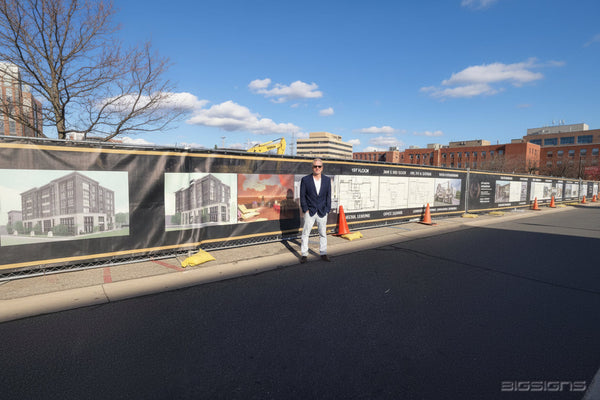
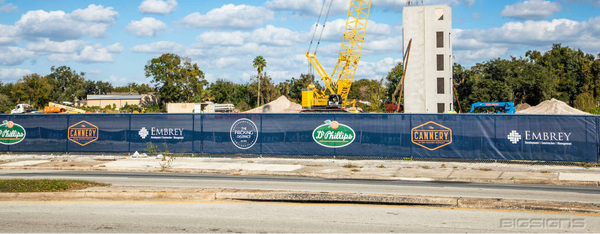
The purpose competitors consistently overlook is that a construction fence screen is the largest piece of advertising real estate most contractors will ever own for free. The perimeter of a job site is already there, already faces the street, and is up for the entire length of the build. A printed screen turns that linear footage into a continuous billboard: developer name, project rendering, leasing or "coming soon" messaging, the general contractor's logo, and trade partners. A bare fence wastes 100 percent of that exposure.
The numbers make the case. A downtown project with 300 linear feet of street-facing fence on a road carrying 15,000 vehicles a day generates more daily impressions than most paid out-of-home placements, at a one-time material cost. Developers use this to pre-lease retail and pre-sell condos before the building tops out, and general contractors use it to win the next job by putting their brand on a clean, professional site. If the perimeter faces a street, a printed mesh vinyl screen pays for itself in impressions and pre-leasing, carrying full-color graphics and logos at billboard scale while micro-perforations still vent air through the weave. Our guide to customizing construction fence screens with logos for branding and compliance covers artwork setup and resolution.
Branding and compliance are not separate goals. The same printed screen that advertises the project can carry the required permit numbers, safety signage, and contractor licensing, so one product satisfies the marketing team and the inspector at once.

Beyond construction: the same screen works for athletics and events
The printed mesh that wraps a job site is the same product family that dresses an athletic field or stadium. Schools and programs use windscreens and printed mesh on outfield fences and court perimeters for the same reasons a job site does: block wind, add privacy, and display sponsor or program branding. If your need extends past construction, the same custom-print approach applies to baseball and softball field screens and tennis court windscreens. The use case changes; the material and the branding purpose do not.
Indoor and storefront projects have their own rules, our guide to retail construction barricades covers mall requirements, graphics options, and costs.
How to choose the right construction fence screen
Choose your construction fence screen by ranking the five purposes for your specific site, then matching the mesh and finish to the top priority. Start with these questions:
1. Is this a security or privacy site? If hiding contents or fully blocking the view is the priority, choose a high-density 85 to 95 percent privacy mesh or a solid screen.
2. Is wind a factor? Tall fences in open or coastal areas need a rated venting mesh, not a solid screen, so the fence does not become a sail.
3. Is branding part of the budget? If the perimeter faces a street, a printed mesh vinyl screen pays for itself in impressions and pre-leasing.
4. How long is the build? A multi-year project justifies a durable, UV-stable screen; a short demolition job can use a budget mesh.
5. What are the dimensions? Standard rolls are commonly 6 feet by 50 feet, but coverage and seam planning depend on your actual run, which our fence screen sizing guide walks through.
Once the spec is set, you can compare every privacy, airflow, and printed option side by side on the construction fence screens collection and match the mesh and finish to whichever of the five purposes matters most for your site.
Frequently asked questions
1. What is a construction fence screen?
A construction fence screen is a knitted mesh or printed mesh vinyl panel that attaches to a chain-link or temporary fence to add privacy, safety, dust and wind control, and branding. It converts an open metal fence into a continuous surface, usually fastened with cable ties or grommets every two feet.
2. What is the difference between a construction fence screen and a privacy windscreen?
A construction fence screen is typically a lighter, printable mesh used for branding and general site coverage, while a privacy windscreen uses a denser weave to fully block sightlines and reduce wind. The main differentiator is material density; privacy windscreens use tighter mesh, and printed screens prioritize graphics. Our screen vs windscreen comparison breaks down which fits your job.
3. Why do construction fences have smiley faces or slits cut into them?
Crews cut slits, sometimes shaped like smiley faces, into solid fence screens so wind can pass through instead of pushing the fence over. A solid screen acts like a sail in a gust, so the cuts relieve wind load. A properly rated venting mesh screen avoids this problem by letting air through by design.
4. How long does a construction fence screen last?
A construction fence screen lasts roughly 2 to 7 years or more depending on the material and UV exposure. Standard polyethylene screens such as EcoScreen are rated for 24 to 48 months outdoors, printed vinyl mesh for 36 to 60 months, and high-wind screens such as PerfectScreen80 for 84 months or more, which matters for multi-year builds.
5. Do construction fence screens block wind?
Yes, but the goal is controlled airflow, not a full seal. A rated mesh screen blocks a portion of the wind and most of the sightline while venting enough air to keep the fence standing. A fully solid screen blocks the most wind but needs reinforcement or slits to avoid being blown over.
6. Can a construction fence screen carry a company logo?
Yes. Printed mesh vinyl screens hold full-color logos, project renderings, and messaging at billboard scale while still venting air. This is the branding purpose that turns a site perimeter into advertising space, and exact artwork and resolution requirements are covered in our logo customization guide and the FAQ page.
Plan your construction fence screen
If you are sizing a screen for a specific site, the fastest path is a quick spec review against your fence run and your top priority, whether that is privacy, wind, or branding. BIGSIGNS offers free design consultation and custom mockups so you can see your logo or project rendering on the screen before you order. Call 800.790.7611 or request a custom quote online and we will help you match the mesh and finish to your job site.

Ready to see your design?
Tell us what you're branding and send your logo. We'll send a free digital mock-up and a quote.
Prefer to talk? Call 800-790-7611
Get A FREE Mock-Up & Quote
Let customers speak for us
The fence scrim was well received on the site. The Superintendent said it was the nicest scrim he's ever had. Great job!

Hi Mario, thanks for following up. The graphic looks great and we are very happy with the results. Thanks so much for the easy process and great service.
Thank you so much!

Everybody loves the product, so we expect to get some more.

It looks great- and the quality is way better than expected. Sorry it was a bit of a hassle. Thanks again!!!

We ordered windscreens to help advertise our new residential development, and they turned out great. Todd Simms was extremely helpful every step of the way—whether it was design, shipping, or answering any questions we had. Overall, excellent customer service and a great product.
Corey I want to thank you for your patience throughout this entire process. You have been fantastic and I am extremely excited to see how these look. Thank you so much.

I chose BIGSIGNS because I was impressed that they have worked with major colleges all over the U.S., and their prices were very reasonable. I absolutely loved working with Mario in sales. I'll admit, I probably wasn't the easiest customer due to my indecisiveness, but he was incredibly patient and helped make the process smooth from start to finish. The team completely nailed our project, and I already recommended them to others. The final result over-exceeded my expectations. This was a big-time project for a smaller school, and my goal was to have people see it and be wowed. Mission accomplished!

Mario, we used the banner as a backdrop for a trade show last weekend. It was a huge success!
We received our step and repeat a couple of days ago and it turned out great!!!! Thank you for your patience working with me until I made a decision on a design. We actually took it to a job fair yesterday and had people comment on it. In fact, I just sent your contact information to a gentleman from Amherst ISD. His name is Jose Gonzales. I hope he contacts you because he seemed very interested. I will definitely refer others to you in the future as well. Once again, thank you for all you did for us. I know we will get many uses out of it.Thanks- Jarod

Let me start off by saying the signage is even more impressive in person than in your brochures or mock ups, which is hard to do. I love most everything about it. Also appreciate you guys busting your ass to get it done for our regionals tomorrow. You should feel free to use me as a reference if desired. The back of the scoreboard was done as well and looked fantastic. The back of the dugout was also done and looked great. Pretty impressive really. Thanks
Over 400,000 runners will cross a Rock n Roll Marathon or 1/2 Marathon finish line, all of them crossing a BigSigns GatorAd finish line, specially formulated as non-slip safe no matter the weather! Thank you, BigSigns!

BIGSIGNS's ModStar gave us the ease of use, customization, and portability we needed. Modstar displayed sponsors for all seventeen nation-wide Game Breakers events; we are now repurposing the existing frames with new branding for our Copa-de-Calle events.

Just wanted to let you know HOW FANTASTIC the banner is. We have had so many compliments on this banner. Thank you!!!

This is Stevie Medina with the Raton Tiger booster club over in Raton. I just wanted to say thank you for those on deck circles. They're amazing. We gave them out to the softball team and the baseball team. And they were super stoked to get them. They loved them. A lot of the kids like, what are those? Those are so cool. Those are so neat. So they really got a kick out of them. Appreciate you. How quickly you guys turn those around. Boy, we had them super fast. I just wanted to say thank you. Thank you much. And no need to return my phone call. I just wanted to let you know that we're enjoying them. And we appreciate all your help on it.

Ordered a door skin for our volleyball program. Customer service department was great ensuring the order was completed correctly in the end. Design team was accommodating with changes & requests to create a great final product!