How Much Wind Do Fence Screens Block? Wind Load, Opacity & Airflow Explained

A mesh fence screen reduces wind by roughly the same percentage as its opacity rating: an 85% screen blocks close to 85% of the airflow passing through it, while a 70% screen lets more air bleed through. That sounds like a simple "buy the highest number" decision, but it is a trade-off. The more wind a fence screen blocks, the more wind load it transfers to your fence posts, and a solid barrier that blocks nearly everything is the fastest way to bend a fence line in a storm. This guide explains how fence screen wind reduction actually works, why opacity and airflow pull against each other, and how to pick the right blockage rating for your wind exposure.
If you manage an athletic field, a construction site, or any fenced perimeter that catches open wind, the right answer is almost never "block the most." It is "block enough while letting the structure survive." Below is the practical engineering behind that decision.
How much wind does a fence screen actually block?
A fence screen blocks wind in direct proportion to its opacity, so a screen rated at 85% blockage reduces roughly 85% of the wind that hits it and lets the remaining 15% bleed through the mesh. Most commercial fence screens fall between 70% and 95% blockage, and that single number drives both the privacy you get and the wind protection on the leeward side. A 70% mesh is the common spec for ball visibility on athletic fields, while 85% to 90% is the workhorse range for privacy and meaningful wind reduction.
The reduction is strongest immediately behind the screen and is not perfectly linear. Research on industrial windbreaks shows a porous barrier creates a sheltered zone extending many times its own height downwind, with the WeatherSolve wind fence resources noting a tall windbreak can calm air for hundreds of feet behind it. The key word is porous: a barrier that lets a little air through protects a longer, calmer zone than a solid wall, because the bleed-through air fills the low-pressure pocket that would otherwise pull turbulence back down behind a solid panel.
For most facilities the practical takeaway is this: a quality mesh screen in the 85% to 90% range will noticeably cut wind, knock down dust, and steady flags and signage, without behaving like a wall. If you want to compare blockage ratings against your specific fence and exposure, our team can run that with you on a free custom quote.

Why opacity and airflow are a trade-off
Higher opacity means more wind blocked but more wind load on your fence, while lower opacity means less protection but a structure that survives high gusts. This is the central tension in choosing a fence screen, and it is why "highest blockage wins" is the wrong instinct. A 98% screen blocks more wind than an 85% screen, but it also catches far more force and transfers that force straight into your posts and footings.
The reason comes down to bleed-through. A breathable HDPE mesh around 85% blockage lets a small amount of air pass, which relieves pressure on the fabric and the frame. A 98% screen or a rigid privacy slat reduces that bleed-through to almost nothing, so it behaves much more like a solid wall. The Sandbaggy wind load guide puts it directly: higher-opacity systems generally create more wind force than lower-opacity mesh because they reduce bleed-through.
For an athletic field where players need to see the ball, a 70% screen is often the right call because it balances visibility, modest wind reduction, and low load. Our high-airflow athletic windscreen is built for exactly that case. If reducing wind load matters more than blocking sightlines, a lightweight fabric windscreen is engineered for exactly that trade-off, the knitted mesh allows up to 50% airflow, so wind passes through instead of pushing against the fence line. For a privacy-first perimeter on a sheltered urban lot, an 85% to 90% screen like our high-opacity athletic windscreen makes sense. The exposure of the site, not the privacy you want, should set the ceiling on opacity.

Why a solid barrier fails when mesh survives
A solid fence screen fails in high wind because it behaves like a sail, catching the full force of the wind and transferring it to posts that were never engineered to hold it. This is the single most common reason fence screens tear, grommets rip out, or whole fence runs lean and collapse. Mesh survives the same storm because it lets enough air through to shed pressure.
The math is unforgiving. Wind pressure scales with the square of wind speed, so doubling the wind from 30 mph to 60 mph does not double the force, it roughly quadruples it. The Sandbaggy guide works a concrete example: under ASCE 7 wind load assumptions at 100 mph, a single 10-foot section of 6-foot fence presenting roughly 60 square feet of solid surface can see on the order of 1,500 pounds of force on that one bay before you even account for gusts. A solid tarp or vinyl panel turns your fence into a 60-square-foot sail, and standard residential posts (around 16-gauge, 0.065-inch wall) are not rated for it.
This shows up constantly in the field. Homeowner forums are full of patio privacy screens knocked flat by wind because someone hung a near-solid screen on a light frame. The fix is rarely a stronger screen; it is a more breathable one, a heavier frame, or both. A loose screen also "parachutes" and flaps, which creates dynamic shock loads that rip grommets faster than steady pressure does, so proper tensioning matters as much as the right mesh.

Wind vents and how they help (and where they fall short)
Wind vents are half-moon or slit openings cut into a screen to let pressure bleed through, and they do reduce wind load, but they do not make a high-opacity screen behave like low-opacity mesh. Manufacturers add them to privacy screens so an 85% blockage panel can shed some pressure during gusts. The Sonco 85% privacy screen with half-moon wind vents is a representative example: the vents let airflow through to reduce pressure while keeping most of the visual blockage.
The limit is that vents are a partial measure, not a substitute for proper structure. Multiple fencing suppliers point out that vented screens still add substantial wind load to temporary fences, and that the vents alone will not stop a fence from blowing over if the bases and posts are undersized. Vents help most on temporary chain link and construction fencing where you want privacy and dust control but cannot upgrade the entire framework.
If you are choosing between a vented high-opacity screen and a naturally breathable lower-opacity mesh, the breathable mesh is usually the safer structural choice for exposed sites. Vents are best treated as one tool among several, alongside tighter post spacing and proper attachment, not as a reason to ignore the load.
How to choose fence screen opacity by wind exposure
Match your fence screen opacity to your site's wind exposure first, then adjust for privacy. The more open and gusty the location, the lower the opacity you should run so the structure can survive. Here is a practical starting framework:
-
Sheltered urban or suburban sites: 85% to 90% blockage is usually safe and gives strong privacy and wind reduction. Most fences in town are surrounded by buildings that break up gusts.
-
Open fields, coastlines, and ridgelines: Drop to roughly 70% to 85% to allow more bleed-through. The Sandbaggy guide specifically recommends lower blockage for fences facing open fields or coasts so the screen does not act like a sail.
- Hurricane and extreme-wind zones: Prioritize structure over opacity. Use breathable mesh, upgrade to commercial Schedule 40 posts, tighten post spacing to 6 to 8 feet, and consider taking screens down ahead of named storms.
Structure carries the screen, so the fence has to match the screen you hang. For high-wind perimeters, a heavy-duty commercial windscreen built for high winds or our GatorScreen heavy-duty fence screen pairs durable fabric with reinforced hems and grommets so the attachment points hold up. Tie every grommet (screens are commonly built with grommets every 12 inches and are meant to be attached at each one), tension the screen so it does not flap, and consider a tie strategy where lighter ties at the top act as a "fuse" that sacrifices a fastener before a gust bends a post. Our fence screen installation guide covers the attachment details, and the sizing guide helps you spec dimensions correctly.

Construction sites vs. athletic fields: different wind priorities
Construction sites prioritize dust control, privacy, and code compliance, while athletic fields prioritize ball visibility and player sightlines, and those different goals point to different opacity choices. They are not the same product decision even though both hang on chain link.
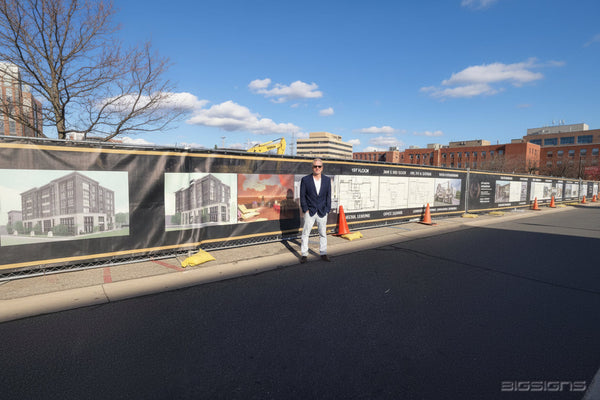
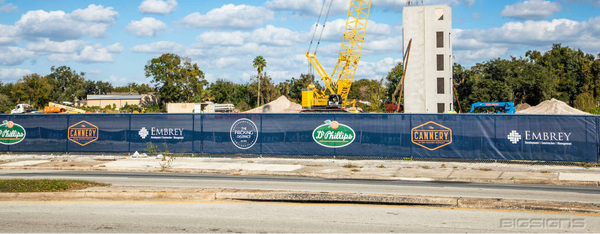
On a construction site, the screen is doing privacy and debris containment, so 85% to 90% blockage is common, often with wind vents on temporary fence panels that have limited base weight. The structural risk is highest here because temporary fencing has lighter footings than permanent fence. A purpose-built construction fence screen in Dura-Mesh gives you that privacy-and-dust profile, and you can browse the full range of construction fence screens by application. For the deeper comparison of the two product families, see our guide on construction fence screen vs. privacy windscreen.
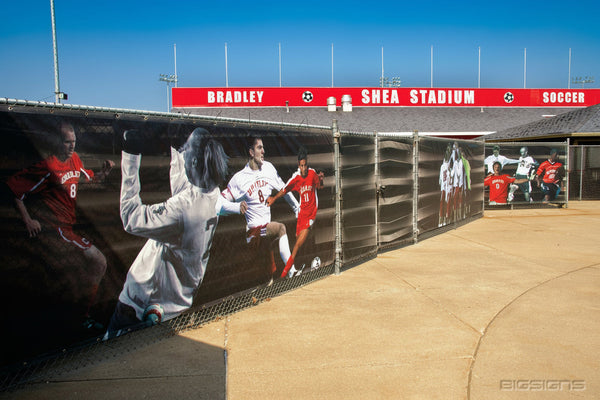
On an athletic field, lower opacity often wins because players and umpires need to track the ball against the screen. The standard guidance from Beacon Athletics is to size windscreen roughly 3 to 6 inches shorter than the fence height and short on each end, which reduces the wind-catching area and the load on the fence at the same time. Backstops, foul lines, and tennis surrounds each have their own visibility needs, which is why our baseball and softball and tennis windscreen lines exist as distinct products, and why the athletic Dura-Mesh fence screen and heavy-duty athletic windscreen with full coverage are spec'd differently. For the full breakdown of types, materials, and customization, see our complete buyer's guide to athletic windscreens.

Frequently asked questions
1. How much wind does an 85% fence screen block?
An 85% fence screen blocks roughly 85% of the wind that hits it and lets about 15% bleed through the mesh. That bleed-through is what relieves pressure on the fabric and keeps the screen from acting like a solid wall.
2. Do privacy fence screens reduce wind?
Yes, privacy fence screens reduce wind in proportion to their opacity, so a higher-blockage screen cuts more wind. The trade-off is that higher blockage also puts more wind load on your fence posts, so very high-opacity screens need stronger structure to stay up.
3. What is the sail effect on a fence screen?
The sail effect is when a high-opacity or solid screen catches the full force of the wind and transfers it to the fence like a sail catches wind. Because wind pressure scales with the square of speed, a solid screen can overload posts that a breathable mesh would not, which is why mesh survives storms that flatten solid barriers.
4. Should I get wind vents in my fence screen?
Wind vents help a high-opacity screen shed some pressure during gusts, so they are worth it on privacy screens for temporary or construction fencing. They are a partial measure, though, not a replacement for proper post size, spacing, and tensioning on exposed sites.
5. What fence screen opacity is best for high wind areas?
For high wind areas, choose a lower opacity in the 70% to 85% range so more air bleeds through and the screen does not act like a sail. Pair it with commercial-grade posts, tighter post spacing, and full grommet attachment, and take screens down ahead of extreme storms.
6. How far apart should fence screen grommets be?
Most quality fence screens are built with grommets every 12 inches, and the screen should be tied at every grommet. Skipping grommets lets the screen flap, which creates shock loads that rip out the remaining attachment points.
Get the right screen for your wind exposure
The right fence screen is the one matched to your site's wind exposure first and your privacy goals second. If you are not sure whether your fence can carry an 85% screen or whether you should drop to a more breathable mesh, BIGSIGNS offers free design consultation and custom mockups to spec it correctly for your field, site, or perimeter. Call 800.790.7611 or request a custom quote and we will help you choose the opacity, fabric, and attachment that will actually hold up.

Ready to see your design?
Tell us what you're branding and send your logo. We'll send a free digital mock-up and a quote.
Prefer to talk? Call 800-790-7611
Get A FREE Mock-Up & Quote
Let customers speak for us
The fence scrim was well received on the site. The Superintendent said it was the nicest scrim he's ever had. Great job!

Hi Mario, thanks for following up. The graphic looks great and we are very happy with the results. Thanks so much for the easy process and great service.
Thank you so much!

Everybody loves the product, so we expect to get some more.

It looks great- and the quality is way better than expected. Sorry it was a bit of a hassle. Thanks again!!!

We ordered windscreens to help advertise our new residential development, and they turned out great. Todd Simms was extremely helpful every step of the way—whether it was design, shipping, or answering any questions we had. Overall, excellent customer service and a great product.
Corey I want to thank you for your patience throughout this entire process. You have been fantastic and I am extremely excited to see how these look. Thank you so much.

I chose BIGSIGNS because I was impressed that they have worked with major colleges all over the U.S., and their prices were very reasonable. I absolutely loved working with Mario in sales. I'll admit, I probably wasn't the easiest customer due to my indecisiveness, but he was incredibly patient and helped make the process smooth from start to finish. The team completely nailed our project, and I already recommended them to others. The final result over-exceeded my expectations. This was a big-time project for a smaller school, and my goal was to have people see it and be wowed. Mission accomplished!

Mario, we used the banner as a backdrop for a trade show last weekend. It was a huge success!
We received our step and repeat a couple of days ago and it turned out great!!!! Thank you for your patience working with me until I made a decision on a design. We actually took it to a job fair yesterday and had people comment on it. In fact, I just sent your contact information to a gentleman from Amherst ISD. His name is Jose Gonzales. I hope he contacts you because he seemed very interested. I will definitely refer others to you in the future as well. Once again, thank you for all you did for us. I know we will get many uses out of it.Thanks- Jarod

Let me start off by saying the signage is even more impressive in person than in your brochures or mock ups, which is hard to do. I love most everything about it. Also appreciate you guys busting your ass to get it done for our regionals tomorrow. You should feel free to use me as a reference if desired. The back of the scoreboard was done as well and looked fantastic. The back of the dugout was also done and looked great. Pretty impressive really. Thanks
Over 400,000 runners will cross a Rock n Roll Marathon or 1/2 Marathon finish line, all of them crossing a BigSigns GatorAd finish line, specially formulated as non-slip safe no matter the weather! Thank you, BigSigns!

BIGSIGNS's ModStar gave us the ease of use, customization, and portability we needed. Modstar displayed sponsors for all seventeen nation-wide Game Breakers events; we are now repurposing the existing frames with new branding for our Copa-de-Calle events.

Just wanted to let you know HOW FANTASTIC the banner is. We have had so many compliments on this banner. Thank you!!!

This is Stevie Medina with the Raton Tiger booster club over in Raton. I just wanted to say thank you for those on deck circles. They're amazing. We gave them out to the softball team and the baseball team. And they were super stoked to get them. They loved them. A lot of the kids like, what are those? Those are so cool. Those are so neat. So they really got a kick out of them. Appreciate you. How quickly you guys turn those around. Boy, we had them super fast. I just wanted to say thank you. Thank you much. And no need to return my phone call. I just wanted to let you know that we're enjoying them. And we appreciate all your help on it.

Ordered a door skin for our volleyball program. Customer service department was great ensuring the order was completed correctly in the end. Design team was accommodating with changes & requests to create a great final product!