Construction Fence Screens vs Temporary Walls: How to Choose for Your Site

Choosing between construction fence screens vs temporary walls comes down to one question: do you need to hide and brand an outdoor perimeter, or do you need a solid, rigid separation? Fence screens win on open job sites where a chain-link or temporary panel fence is going up anyway. Temporary walls win inside occupied buildings, along mall storefronts and wherever the local code or the landlord calls for a solid barrier.
This guide compares the two on privacy, wind load, security, codes, branding and reuse. It also lists outdoor lifespans for BIGSIGNS screens, so you can match the barrier to the site before you order.
Construction Fence Screens vs Temporary Walls at a Glance
A construction fence screen is a mesh or vinyl panel tied to a chain-link or temporary fence, while a temporary wall is a freestanding solid barrier built from panels or framing. The table below shows where each one fits.
| Construction fence screen | Temporary wall | |
|---|---|---|
| What it is | Printed or plain mesh or vinyl tied to chain-link or temporary fence panels | Plywood hoarding, modular wall panels or a fabric graphic on a frame |
| Best setting | Outdoor site perimeters | Occupied buildings, mall storefronts and sites where code requires a solid fence |
| Privacy | 65% to 98% visibility blockage, depending on the screen | Full |
| Wind | Mesh lets some wind through; denser screens put more load on the fence | A solid face takes the full wind load and needs bracing or ballast outdoors |
| Security | Visual screening; the fence itself controls access | A physical barrier between the work and the public |
| Dust and noise | Some dust and debris control, little noise control | Better dust and noise containment |
| Installation | Tied to the fence line with ties or hog rings | Built or assembled on site |
| Reuse | Removed, rolled and reused | Modular panels and frames are reused; plywood hoarding is usually demolished |
When a Construction Fence Screen Is the Better Choice
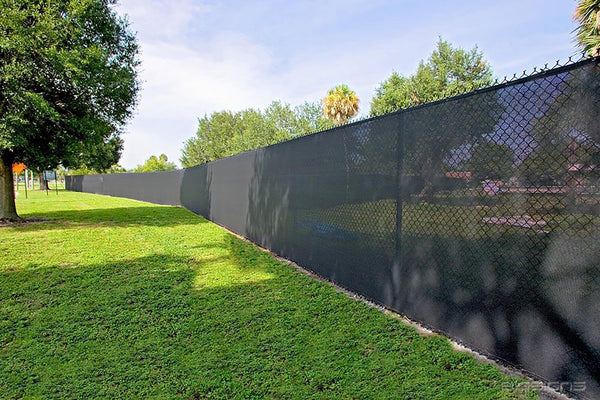
A construction fence screen is the better choice for an outdoor site that already has a chain-link or temporary panel fence and needs privacy, dust control and branding without building anything new. The screen ties to the fence, so it goes up with the fence line and moves with it when the site layout changes.
Screens also let you choose how much the fence hides against how much wind passes through. A 65% blockage mesh such as DuraMesh™ lets about a third of the wind through and takes full-color printing, while a 90% screen such as EcoScreen90™ hides more of the site at a budget price. For a ready-made privacy option, see the Construction85™ pre-made privacy construction fence screen.
Lifespan depends on the material, so compare screens by product rather than by an industry average. These are the outdoor ratings BIGSIGNS gives its construction screens:
| Screen | Outdoor lifespan | Visibility blockage | Best for |
|---|---|---|---|
| EcoScreen90™ | 24 to 48 months | 90% | Budget-friendly screening with limited branding |
| LogoScreen™ Economy | 24 to 48 months | 90% | Repeated 1-color or 2+ color screen-printed logos |
| LogoScreen™ Premium | 36 to 60 months | 88% | Full-color repeated logos |
| DuraMesh™ vinyl mesh | 36 to 60 months | 65% | Full digital printing and development renderings |
| PerfectScreen80™ | 84+ months | 80% | High-wind sites with limited branding |
| Privacy98™ | 24 to 48 months | 98% | Maximum privacy with minimal airflow |
Privacy100™ is made for indoor use only, so it does not belong on an outdoor perimeter. To weigh printed fabric against vinyl mesh, read fabric vs vinyl mesh construction fence screens, or compare every option in the construction fence screens collection.
When You Need a Temporary Wall Instead
You need a temporary wall when the barrier has to be solid: inside an occupied building, along a storefront that stays open to the public, or on a site where the code calls for a solid fence. A fence screen hides a site, but it does not separate a work zone from shoppers, contain dust inside a shared building or satisfy a rule that says the enclosure must be solid.
Most retail and interior projects use one of three systems: rigid modular wall panels, fabric barricade displays and plywood hoarding. They differ most on install speed, cleanliness, reuse and graphics quality, as the retail construction barricades buyer's guide explains in detail.
Fabric barricade displays such as Wonderwall™ retail barricades put a dye-sublimated fabric graphic on a reusable frame. When the project moves to its next phase, the graphic can be replaced while the frame stays in place, which cuts downtime and disruption between phases.
Outdoors, a temporary wall usually means plywood hoarding on a frame. It blocks every sightline, but a solid face acts like a sail, so it needs more anchoring, ballast or bracing than an open fence, as Ameribuilds' temporary fencing materials guide points out.
Wind Load Often Makes the Decision Outdoors
On an outdoor site, wind load decides more projects than privacy does. ASTM F3342-19, the Standard Guide for Temporary Fence Applications for Construction Sites, states that wind screens applied to a fence form a solid barrier and advises designing a screened temporary fence the same way as a permanent fence (ASTM F3342-19).
That makes screen choice a wind decision. Higher-airflow mesh puts less stress on the fence, which is why a mesh with about 35% wind pass-through performs better on exposed sites than a near-solid privacy screen. For high-wind locations, BIGSIGNS recommends PerfectScreen80™, rated for 84 months or more outdoors.
How the screen is fastened matters as much as which screen you pick. BIGSIGNS installation instructions call for:
- Ties every 12 to 18 inches on standard vinyl mesh and every 18 to 24 inches on fabric mesh, closer together in high wind
- Every grommet, corner and reinforced hem secured
- A screen that flexes slightly in gusts, never drum-tight, because over-tightening is one of the most common causes of early failure
- Lighter tension and heavy-duty UV-rated zip ties on temporary construction fence panels, which move more than permanent chain link
The full steps are in the fence screen installation guide. If the fence cannot carry the extra load of a screen, a solid wall braced and ballasted for the site's wind is the safer route.
Codes and Landlord Rules Can Decide for You
Before comparing materials, check whether a rule has already made the choice. Outdoors, construction fence rules come from the local building department; indoors, they usually come from the landlord's construction criteria.
New York City is a clear example. The NYC Department of Buildings requires a construction fence at least 8 feet high around new building sites, built solid for its entire length out of wood or other suitable materials, and approves chain link only in listed cases such as one-, two- or three-family buildings (NYC Department of Buildings). On a site covered by that rule, the solid fence is the requirement and a screen on chain link is not.
Inside shopping centers, the lease workletter or Tenant Criteria Manual sets the barricade's height, finish and graphics, and many criteria manuals call for fire-rated finish materials on the public side, according to our retail barricades requirements guide. Rules vary by city and by property, so confirm them with your building department or landlord before you order a screen or a wall.
Branding: What Each Option Can Carry
Both options carry branding, but differently: a screen prints along the whole fence run, while a wall puts a finished graphic in front of foot traffic. The right choice depends on who sees the barrier and from how far away.
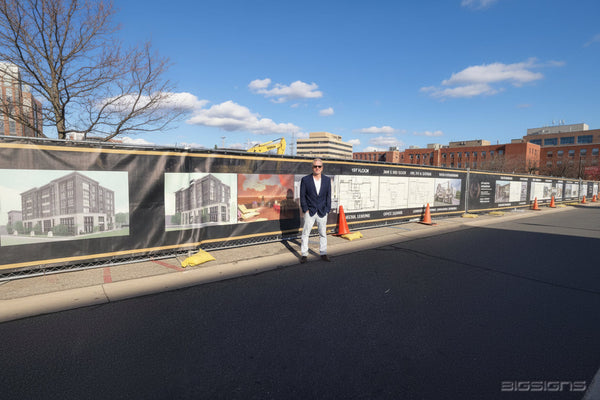
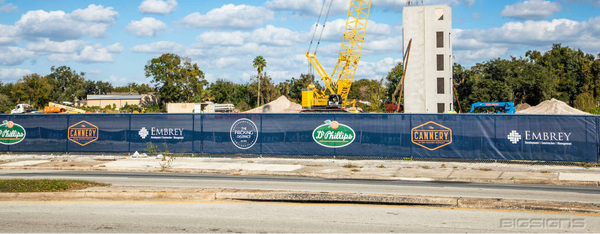
On job sites, the choice is between repeated logos and full graphics. LogoScreen™ Premium prints full-color logos repeated along the run, LogoScreen™ Economy repeats 1-color or 2+ color screen-printed logos on a budget screen, and DuraMesh™ takes full digital printing, including development renderings.
A storefront barricade sits in front of shoppers who are already in the building, which is why retailers treat it as advertising space. A typical mall barricade runs about 50 feet of storefront (retail barricades buyer's guide), and a fabric frame system lets the message change between phases without building a new wall.
Install Time, Reuse and What Drives the Cost
A fence screen is usually the lower-cost route when a fence is already planned, because it needs no framing or sheathing and goes up with ties. A temporary wall adds materials and labor to build, and outdoors it adds bracing or ballast for wind.
Reuse changes the math over several projects. Screens can be cleaned, dried, rolled loosely and stored indoors for the next site; modular wall panels and fabric frames move to the next project; plywood hoarding usually ends up demolished.
Custom screens and barricades are sized and printed for each site, so the fastest way to compare cost is to get both options quoted for your actual layout. Length of run, material and graphics drive the difference more than the barrier type alone.
Frequently Asked Questions
Is a fence screen or a temporary wall cheaper?
A fence screen is usually cheaper when the site already has a chain-link or temporary panel fence, because it needs no framing and installs with ties. A temporary wall costs more to build and, outdoors, to brace against wind, though modular and fabric-frame walls can be reused on later projects.
How long do construction fence screens last outdoors?
It depends on the material. BIGSIGNS rates its budget poly screens at 24 to 48 months outdoors, its vinyl mesh and premium logo screens at 36 to 60 months, and PerfectScreen80™ at 84 months or more.
Can you use a fence screen inside a mall or an occupied building?
Usually not. Shopping centers and occupied buildings typically require a solid barricade wall set by the landlord's criteria manual, often with fire-rated finishes on the public side, so check the lease workletter before ordering.
Do fence screens reduce construction noise?
Only slightly. A fence screen is designed for privacy, dust control and branding, while a solid wall does a far better job of containing noise.
How far apart should fence screen ties be?
Space ties every 12 to 18 inches on standard vinyl mesh and every 18 to 24 inches on fabric mesh, closer together in high wind. Secure every grommet, corner and reinforced hem, and leave the screen slightly flexible rather than drum-tight.
Which fence screen is best for a windy site?
Choose a higher-airflow screen and fasten it closely. A mesh with more wind pass-through, or a high-wind screen such as PerfectScreen80™, puts less load on the fence than a near-solid privacy screen.
Do building codes ever require a solid construction fence?
Yes, some do. New York City requires construction fences at least 8 feet high and built solid for their entire length around new building sites, approving chain link only in listed cases, so check with your local building department before planning a screened chain-link fence.
Get a Recommendation for Your Site
Not sure which barrier your project needs? BIGSIGNS can review your site layout, recommend a fence screen or a barricade system and send a free design mockup. Call 800.790.7611 or request a quote online to get started.

Ready to see your design?
Tell us what you're branding and send your logo. We'll send a free digital mock-up and a quote.
Prefer to talk? Call 800-790-7611
Get A FREE Mock-Up & Quote
Let customers speak for us
The fence scrim was well received on the site. The Superintendent said it was the nicest scrim he's ever had. Great job!

Hi Mario, thanks for following up. The graphic looks great and we are very happy with the results. Thanks so much for the easy process and great service.
Thank you so much!

Everybody loves the product, so we expect to get some more.

It looks great- and the quality is way better than expected. Sorry it was a bit of a hassle. Thanks again!!!

We ordered windscreens to help advertise our new residential development, and they turned out great. Todd Simms was extremely helpful every step of the way—whether it was design, shipping, or answering any questions we had. Overall, excellent customer service and a great product.
Corey I want to thank you for your patience throughout this entire process. You have been fantastic and I am extremely excited to see how these look. Thank you so much.

I chose BIGSIGNS because I was impressed that they have worked with major colleges all over the U.S., and their prices were very reasonable. I absolutely loved working with Mario in sales. I'll admit, I probably wasn't the easiest customer due to my indecisiveness, but he was incredibly patient and helped make the process smooth from start to finish. The team completely nailed our project, and I already recommended them to others. The final result over-exceeded my expectations. This was a big-time project for a smaller school, and my goal was to have people see it and be wowed. Mission accomplished!

Mario, we used the banner as a backdrop for a trade show last weekend. It was a huge success!

We received our step and repeat a couple of days ago and it turned out great!!!! Thank you for your patience working with me until I made a decision on a design. We actually took it to a job fair yesterday and had people comment on it. In fact, I just sent your contact information to a gentleman from Amherst ISD. His name is Jose Gonzales. I hope he contacts you because he seemed very interested. I will definitely refer others to you in the future as well. Once again, thank you for all you did for us. I know we will get many uses out of it.Thanks- Jarod

Let me start off by saying the signage is even more impressive in person than in your brochures or mock ups, which is hard to do. I love most everything about it. Also appreciate you guys busting your ass to get it done for our regionals tomorrow. You should feel free to use me as a reference if desired. The back of the scoreboard was done as well and looked fantastic. The back of the dugout was also done and looked great. Pretty impressive really. Thanks
Over 400,000 runners will cross a Rock n Roll Marathon or 1/2 Marathon finish line, all of them crossing a BigSigns GatorAd finish line, specially formulated as non-slip safe no matter the weather! Thank you, BigSigns!

BIGSIGNS's ModStar gave us the ease of use, customization, and portability we needed. Modstar displayed sponsors for all seventeen nation-wide Game Breakers events; we are now repurposing the existing frames with new branding for our Copa-de-Calle events.

Just wanted to let you know HOW FANTASTIC the banner is. We have had so many compliments on this banner. Thank you!!!

This is Stevie Medina with the Raton Tiger booster club over in Raton. I just wanted to say thank you for those on deck circles. They're amazing. We gave them out to the softball team and the baseball team. And they were super stoked to get them. They loved them. A lot of the kids like, what are those? Those are so cool. Those are so neat. So they really got a kick out of them. Appreciate you. How quickly you guys turn those around. Boy, we had them super fast. I just wanted to say thank you. Thank you much. And no need to return my phone call. I just wanted to let you know that we're enjoying them. And we appreciate all your help on it.

Ordered a door skin for our volleyball program. Customer service department was great ensuring the order was completed correctly in the end. Design team was accommodating with changes & requests to create a great final product!